

The Whole Body Growth Framework
10 questions for building a sacred community growth plan through love, trust, and mutual care


“…the body is not made up of one part but of many.” (1 Corinthians 12:14)
Healthy church & ministry growth — the kind that is loving, non-manipulative, selfless, and sustaining — requires wide wisdom and the perspective of the whole. This is why I write about sacred community building being “slow work.”
There are no shortcuts.
There is not one lever to pull that will fix everything.
There aren’t just a couple of social media tricks… or just a few tweaks to the Sunday worship experience that will lead to a thriving church or ministry.
The hands and the heart of your church or ministry must be aligned with the eyes and the ears and the soul of your church or ministry. The whole body is where wisdom lies.
Paul’s metaphor in 1 Corinthians holds. He writes of the early church with a beautiful systems-thinking mindset, “there should be no division in the body, but that its parts should have equal concern for each other. If one part suffers, every part suffers with it; if one part is honored, every part rejoices with it.” (1 Corinthians 12:25-26)
With that in mind, I’ve been asked by churches and ministries I care about to help them think holistically about growth… not as one tactic, one program, or one leader’s responsibility… but as the long-term, slow work of tending the whole body of sacred community.
The answers are not ready-made.
Good answers to the growth question only come from sacred conversations that consider the whole body. So the conversations that follow these ten questions are where we start building a slow, sacred community growth strategy.
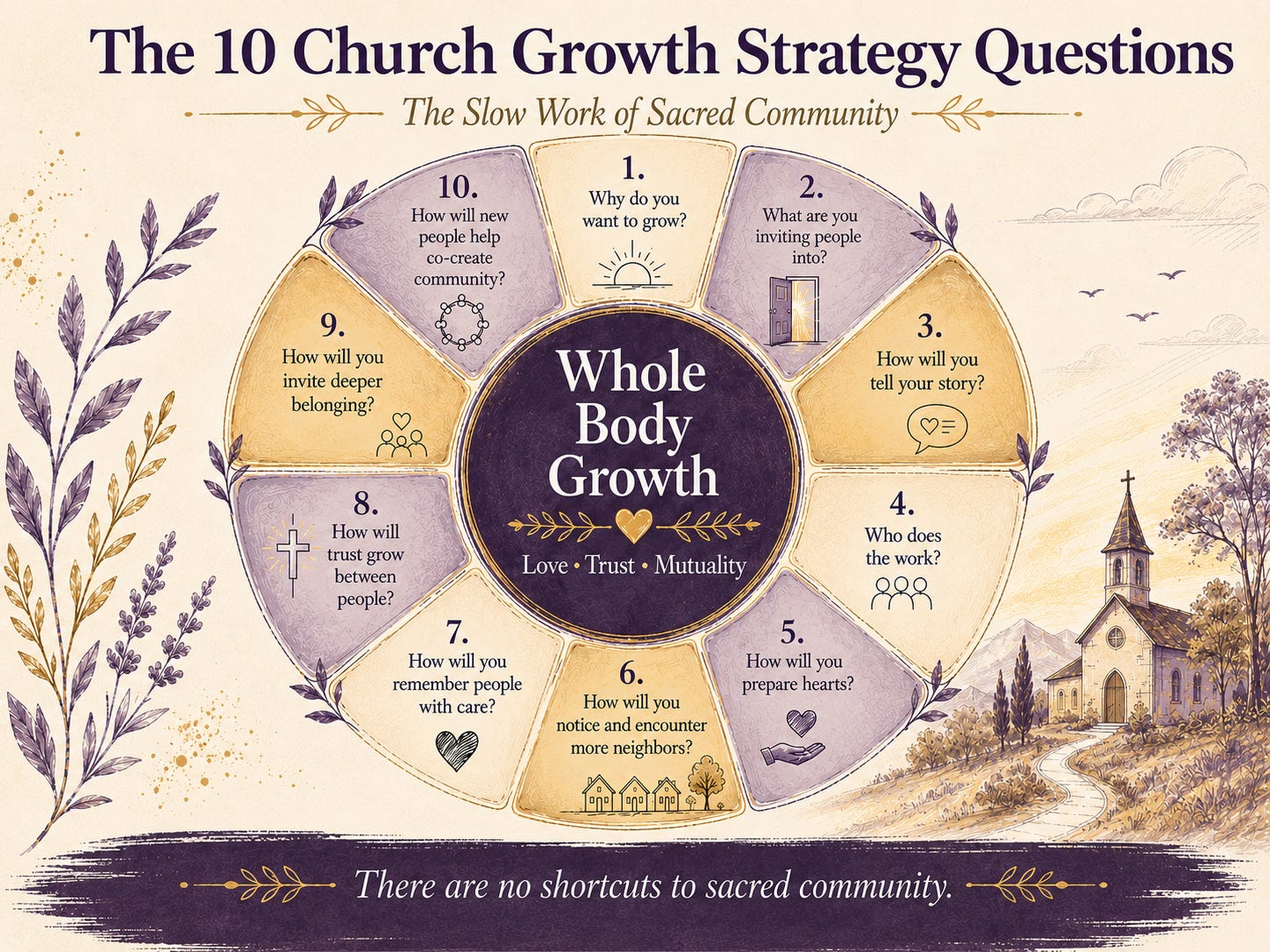
1) Why do you want to grow?
Identifying your motivation matters. If you are driven to grow your ministry by self-serving reasons, you’ll likely get it wrong — and may hurt people along the way.
Don’t grow because your institution is scared. Don’t grow because your ego needs a win. Don’t grow because your budget demands more bodies. Don’t grow because the church or ministry down the road has more people showing up.
Grow because your neighbors are lonely. Grow because your neighbors are hungry. Grow because your neighbors are searching for meaning, belonging, transcendence, and care. Grow because your ministry is a gift for people who are ready for it. Grow because sacred community should not be hidden from people who long for it. Grow for them.
And if your growth ever stops feeling like love, stop and ask better questions.
2) What are you inviting people into?
Before you invite people, get clear on the gift you are offering. What is the story? What is the promise? Who is it for? What kind of sacred community are you opening a door into?
Clarity matters. Not hype. Not branding tricks. But honest, human language about who you are, why you exist, who you serve, and what kind of belonging you are opening the door to. If people can’t understand the gift, they probably won’t know how to receive it.
Too many churches or ministries are unclear about why they exist or what the point of their togetherness is. Yes… Jesus. But there are a lot of variations on that, obviously, so being clear is being kind to your neighbors.
3) How will you tell your story in ways that make trust-filled connection more likely?
Your ministry or church has a beautiful story to tell. That story, when told right, should result in deepened trust and beautiful human-to-human connections.
Marketing, when done well, is not manipulation — it can truthfully help people understand who you are, what you value, and why they might feel safe taking a next step. Your public story should soften the ground for authentic relationships, not replace them.
And all of your marketing efforts should point people toward each other. A church or ministry is not a brand or a building. It is the way your beliefs come alive in the space between people. So every marketing effort — whether it’s social media, a sponsorship, a booth at a local festival, direct mail, outdoor advertising, fliers, or any of the hundreds of “marketing tactics” we could imagine together — every marketing effort should lead people toward real moments of sacred human connection.
4) Who does the work?
Growth rooted in sacred connection cannot be carried by clergy alone. A single leader can not hold all this weight well.
As Jethro told Moses, who was taking on too much by himself, “The work is too heavy for you; you cannot handle it alone.” (Exodus 18:18)
Most churches and ministries need roles they have never clearly named: storytellers, inviters, connectors, follow-up people, event hosts, data stewards, hospitality leaders, social media voices, community listeners, neighborhood bridge-builders, and people who simply notice who is missing.
Most churches and ministries have outdated shared-work structures that could benefit from reexamination (i.e. an Outreach Committee charged with marketing tactics, but few other defined roles to take on any of the other growth-oriented tasks).
Clergy matter deeply. But clergy should not be the only ones carrying the work of connection.
If growth is about sacred mutuality, then the work must be shared. The community needs people who can tell the story, create the gathering, remember the names, make the introductions, follow up with care, and help the next person belong.
A church centered on sacred connection does not ask one pastor to be the whole body. It helps the whole body practice love.
5) How will you prepare the hearts of your current members to seek out sacred encounters?
In order for a church or ministry to grow outward, its people need to be formed inwardly. They need to be reminded, again and again, that sacred connection is not a side project or a growth tactic. It is the way of Jesus.
Part of the reason so much church growth is transactional in nature is that it is framed as a side task. A to-do item. “Get more people in the door so we can do church.” But I believe healthy, growing churches see sacred encounters, deepening relationships, and the practice of knowing our neighbors, walking with our neighbors, and nourishing our neighbors as exactly what it means to do church.
Current members need help practicing curiosity, courage, generosity, hospitality, attention, authentic vulnerability, and follow-up. They need to learn how to notice the lonely, welcome the unfamiliar, make introductions, ask better questions, and believe that sacred encounters can happen anywhere.
A growth strategy that skips the formation of the current community will likely become staff-driven, program-dependent, and exhausting.
But when the people themselves begin to believe that the space between them and their neighbors is sacred, growth becomes less about adding one more thing to the calendar and more about awakening to a shared way of life.
A church does not grow because a few leaders care about growth. A church grows when the whole body begins to practice love outwardly.
(Wondering where to start this work? I’ll humbly offer this.)
6) How will you notice and encounter more neighbors?
You cannot walk with, love, feed, or nourish people you have not yet noticed. Many ministries are surrounded by spiritually hungry people they have never learned how to see. You’ll have a zero percent chance of loving the neighbors you have never met and that you don’t know exist.
Churches and ministries often assume connection begins when someone walks through the door or shows up at a big church event. But sacred encounters often begin somewhere else: coffee shops, grocery stores, campus lawns, service projects, shared meals, social media comments, personal texts, one-on-one conversations, neighborhood events, and moments of real need.
Jesus did not wait in the temple for people to come find him. He moved through towns, walked dusty roads, sat at humble tables, showed up thirsty to wells, found fishermen on the shore, sat on hillsides... He noticed people along the way, in the crowd, and even climbing trees. His ministry was not static. It was encounter.
The first work of growth is outward attention. Building multiple pathways of sacred encounter that reach out into the community and allow for new people to be noticed and known — this is the most important task for most churches or ministries that want to grow.
7) How will you remember people with care?
In other words… How will you tend and track the depth of relationships forming between our community and our neighbors?
A names list of neighbors and new connections should not merely store contact information. It is not a sales tool. When done well, it should help you remember names and interactions, notice where trust is growing, identify needs, and follow up with care.
If the space between us is sacred, then we should steward it with tenderness. We should have rhythms in place to remember the people we have encountered and intentionally show up for them with love.
People are not data points. They are not leads. They are not projects. They are beloved human beings whose stories have been entrusted to us.
A church or ministry that wants to grow should be able to answer these questions about the people who are not yet members: Who are we remembering? Who are we following up with? Who is becoming more connected? Who might be slipping through the cracks? Who needs care? Who needs an invitation? Who needs to be seen again?
Because sacred community is not only created in the first encounter.
It is created when someone realizes: They remembered me.
8) How will trust grow between people?
In other words, what will be your strategy for relationship building? When you get to know a neighbor, how will you walk with them toward a long-term, trusting relationship so that, together, you can discern what kind of belonging, participation, friendship, or shared life is actually right?
Events matter. Worship matters. Programs can matter. But sacred community is formed through repeated, trustworthy encounters, filled with care, over time.
A faithful growth strategy asks: how will people move from being welcomed to being known, from being known to being connected, from being connected to becoming part of a web of mutual care?
A faithful strategy considers the stages of relational depth (ie. stranger —> known —> explorer —> participant —> communer) and matches those with appropriate, safe, thoughtful interactions.
The goal is trust, mutuality, and sacred connections — not a sales pitch about the church/ministry or a rushed invitation to “COME TO OUR CHURCH!” for someone that might not receive that well.
The invitation should match the relationship. Some neighbors will cherish one-on-one coffees, phone calls, or text messages. Others will value small group outings, casual life experiences, or friendly meals with a handful of folks. Eventually, when trust has grown, traditional church events and worship are beautiful ways to share the gathered spirit. Trust grows when the invitation matches the relationship.
9) When trust has grown, how will you invite people into a deeper form of belonging?
Don’t leave people in vague warmth.
Lingering as an un-embraced participant on the edges is not a great way to feel loved. Offer clear, gentle next steps into belonging, contribution, care, and shared life.
Let me be clear: this is not an altar call. This is not a coercive invitation that pressures a neighbor into proving commitment, pledging loyalty, or becoming a number in our institutional success story.
Coercive invitations pressure people to perform belonging.
Sacred invitations help people receive and practice belonging.
A coercive invitation requires our new community members to… Decide now. Prove yourself. Cross the line. Join us. Agree with us. Be counted. Make us feel successful.
A sacred invitation invites our new community members to know… You are already loved. There is room for you. There is a place for you. Take it freely, when you are ready. If this isn’t the right place for you, that’s totally OK with us. We would be honored to walk with you in whatever way is faithful and good.
There are moments when a personal, love-filled invitation into a clearer form of belonging is not only appropriate — it can be transformational.
That invitation might be a new member class. It might be a small group. It might be a leadership role. It might be a simple gift or symbol of belonging. It might be a handwritten note. It might be a collective blessing. It might be an invitation to help create what comes next.
These threshold moments matter.
For many people today, however, formal religious invitation is charged with cultural expectations, baggage, and harm. So these moments need to be held softly. If people experience the invitation as a requirement of doctrinal alignment, guilt-driven obligation, or institutional loyalty, we have probably moved too fast or asked too much.
The point is not to trap people. The point is to help them know there is a door.
A community that never invites people deeper may feel gentle, but it can also become vague. And vague warmth is not the same as belonging. If people are beginning to trust you, honor that trust with a clear, loving, pressure-free invitation into shared life.
Not because you need to count them. Because they deserve to know there is a place for them.
10) How will new people help co-create the community they need?
Sacred community is not a product people consume. It is a life people help make together.
Growth deepens and lasts when new people are not merely welcomed into what already exists, but invited to help shape what is becoming. Engaged. Re-invited and re-ignited over and over into the mutuality of community.
Ask them to offer care, share gifts, tell stories, host conversations, make introductions, notice others, and help the next person belong. A role. A task. A job. A way to put their divine gifts into practice.
I believe that people will not only “join” your sacred community, but help co-create it when they…
Have a small group of close friends within the community.
Have a role to play for the community.
Have a story to tell about why the community matters to them.
These questions are not meant to provide easy answers.
They are meant to lead to sacred conversations.
The wisdom is not hidden inside this resource. The wisdom will emerge in the room — among the people who care deeply about your church or ministry, who know its stories, who carry its hopes, who understand its wounds, and who are willing to listen for what the Holy Spirit may be saying now.
Let these questions slow you down. Let them open honest conversation. Let them help you notice what needs care, clarity, and love.
I’m on your team. I’m standing alongside you.
The slow work of sacred community is not easy. These are the exact same questions I continue to let work on me, on BETWEEN, and on the churches and ministries I’m directly involved with.
There are no perfect answers. But there are beautiful people like you who want to share sacred community with others.
There are neighbors who need what your community has been given to share.
There is holy work to do.
May it be so.